
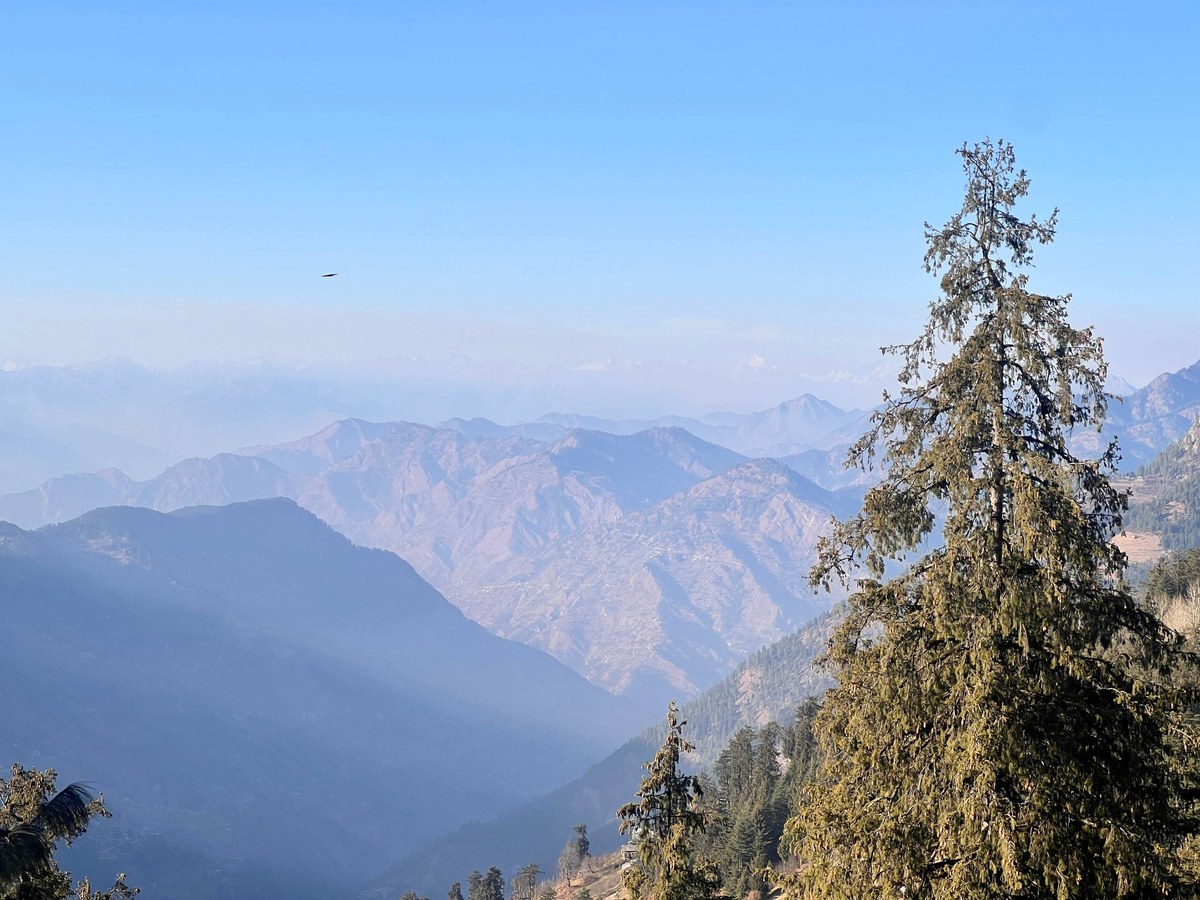
Things to do · Sainj valley
Sainj valley: the other gateway to the Great Himalayan National Park
Where it is, Shangarh and the tower temples, the park's Sainj-side treks, distances from Jibhi, weather by month and the monsoon warning.
Short answer: the Sainj valley is the valley of the Sainj river in eastern Kullu district, one of the two main gateways to the Great Himalayan National Park. Sainj village (PIN 175134) is at about 1,250–1,300 m and about 41 km from Jibhi by road via Banjar and Larji; Shangarh meadow is about 55 km. Go between April and June or in October–November; avoid July and August.
Searching for the Sainj valley? We host guests in Chhet, a few minutes past Jibhi in the Tirthan valley, and the Sainj is the valley next door: the other way into the Great Himalayan National Park. Here is where it is, its height and PIN code, the places to visit, the park's Sainj-side treks, distances from Jibhi, the weather by month and the honest monsoon picture.
Where is the Sainj valley?
The Sainj valley is in the eastern part of Kullu district, Himachal Pradesh. It follows the Sainj river, which runs down "past a series of interlocking spurs before merging with the River Beas at the village of Larji", in the words of the park (GHNP: Sainj Valley). Larji is the same place where the Tirthan, our river, meets the Beas, so the two valleys split at one spot: see our Larji guide.
The park calls the Tirthan and the Sainj its two primary gateways, each leading to a different part of the park (GHNP: accessing the park). The Sainj river itself starts high inside the protected area: UNESCO's listing names the source origins of the Jiwa Nal, Sainj and Tirthan rivers as part of the World Heritage property (UNESCO: Great Himalayan National Park Conservation Area). Local news reports also call the river at Sainj the Pin Parbati (The Tribune, 12 Jul 2023, news).
| Sainj valley | At a glance |
|---|---|
| Where | Eastern Kullu district, Himachal Pradesh; the valley of the Sainj river, which joins the Beas at Larji |
| Park | One of the two main gateways to the Great Himalayan National Park; part of the valley is the Sainj Wildlife Sanctuary |
| World Heritage | Inside the Great Himalayan National Park Conservation Area (UNESCO, 2014) |
| PIN code | 175134 (Sainj sub post office) |
| Height | Sainj village about 1,250–1,300 m by elevation models, roughly 500 m below Jibhi; Shangarh about 2,150 m |
| Trek road-head | Neuli (park range office at Ropa, a little before it) |
| From Jibhi | About 41 km to Sainj village by road, via Banjar and Larji |
| Good for | A meadow day at Shangarh, old wooden temples, the river, and the park's Sainj-side treks |
PIN: Sainj SO, 175134, Kullu district (India Post pincode directory (data.gov.in)). Heights: Copernicus GLO-90 and SRTM elevation models at the OpenStreetMap village points (Sainj village 1,302 / 1,254 m; Shangarh 2,146 / 2,153 m); the park's trek pages give Neuli as 1,500 m. Distances: our route check on OpenStreetMap data, rounded.
The Sainj Wildlife Sanctuary and the World Heritage site
- A sanctuary inside a World Heritage site: the Great Himalayan National Park Conservation Area was inscribed by UNESCO in 2014 and covers 90,540 hectares. It takes in the national park and two wildlife sanctuaries, the Sainj and the Tirthan (UNESCO: Great Himalayan National Park Conservation Area).
- People live here: UNESCO notes that the Sainj Wildlife Sanctuary had about 120 inhabitants when the site was listed (UNESCO: Great Himalayan National Park Conservation Area). The park names Shakti and Maror as villages on its outskirts that are part of this protected area, still living a traditional life, and gateways for treks into the park (GHNP: Sainj Valley).
- Rules apply: entry to the park is by permit, and the rules forbid pets, parties, open fires, hunting and fishing inside it (GHNP: fees, rules and guidelines). If you are travelling with a dog, keep the day to the villages and the road; our pet-friendly stay guide has more.
Places to visit in the Sainj valley
- Shangarh meadow: the best-known stop, a wide green meadow "framed by dense pine forests and snow-capped peaks" (GHNP: Sainj Valley). Shangarh sits at about 2,150 m by elevation models. If you are choosing between Shangarh and Jibhi for a whole trip, our Jibhi or Shangarh comparison covers it.
- The wooden tower temples: the park describes tall wooden temples built not only for worship but also to protect villages from raids, many of them centuries old. The temple at Shangarh was destroyed in a fire in 1998 and has since been rebuilt (GHNP: Sainj Valley).
- Manu temple at Sensher: listed by the park as "a revered spiritual site" in the valley (GHNP: Sainj Valley). Ask locally for the way; we have not been.
- The Sainj river: clear and fast, with forest on both sides higher up. Look, do not wade: see the safety section below.
- Forest and birds: the park lists natural forest areas among the valley's attractions, and its season calendar puts the best birding months at March to June and September to November (GHNP: season-based activities).


Treks from the Sainj side of the park
The park's Sainj-valley treks begin at Neuli, at the road-head (GHNP: accessing the park). Permits for the core zone are issued at the head office in Shamshi and at the range offices in Sairopa (Tirthan valley) and Ropa (Sainj valley) (GHNP: fees, rules and guidelines). These are the park's own trek descriptions:
| Trek | Length | Route and heights |
|---|---|---|
| Neuli to Homkhani Moderate to heavy | 5 days, 56 km round trip | Neuli (about 1,500 m) → Shakti (2,100 m) → Homkhani meadow (2,800 m) |
| Raktisar Moderate to strenuous | 7 days, 92 km in all | Neuli → Shakti → Parkachi thach (3,000 m) → Raktisar (4,500 m), the source of the Sainj |
| Jiwa Nal valley Experienced trekkers only | Multi-day; starts at Siund | Remote, with no trail markers |
From the park's trek pages (GHNP: Neuli to Homkhani trek; GHNP: Raktisar trek; GHNP: Jiwa Nal valley). The Jiwa Nal treks start at Siund, which the park places at the meeting of the Jiwa and Sainj rivers (GHNP: accessing the park).
- Permits and guides: both treks need a permit from the park office and the park advises a local guide; multi-day trekkers must engage certified guides and porters (GHNP: fees, rules and guidelines). The Raktisar route is unmarked in several stretches (GHNP: Raktisar trek).
- When to trek: the park says trekking in the core zone is best from April to June and again from September to November (GHNP: season-based activities).
- No motor safaris: everything inside the park is on foot (GHNP: fees, rules and guidelines). For a shorter walk on our side, see the Tirthan valley park guide and treks near Chhet and Jibhi.
How to reach the Sainj valley from Jibhi
By road you go round, not over the ridge: OpenStreetMap routing takes you down NH-305 from Jibhi through Banjar to Larji, then up the Sainj road (OpenStreetMap). The park's own route to its Sainj treks runs the same way, through Larji to Sainj (GHNP: accessing the park).
| Route | By road | Which way |
|---|---|---|
| Jibhi → Sainj village | About 41 km | Down NH-305 past Banjar to Larji, then up the Sainj road |
| Banjar → Sainj village | About 34 km | Down to Larji, then up the valley |
| Larji → Sainj village | About 14 km | The road that turns off at the three-river meeting |
| Sainj village → Neuli | About 10 km | On up the valley to the trek road-head |
| Sainj village → Shangarh | About 14 km | A narrow side road up to the meadow |
| Jibhi → Shangarh | About 55 km | A long day out, or a night in the valley |
- Plan the day: Sainj village and back is a long half-day from Chhet; add Shangarh and it is a full day. Leave after breakfast and aim to be back before dark, especially in winter.
- The Shangarh road: the park's access page says the gravel road up to Shangarh is "very narrow and only suitable for four-wheel-drive vehicles" (GHNP: accessing the park). Roads change, so ask in Sainj before you drive it, or go up with a local taxi.
- Snacks and water: Banjar is the market town on the way down; stock up there.
Sainj valley weather by month
| Month | Avg high / low at Sainj village (model) | What it is like |
|---|---|---|
| Jan | 14°C / 0°C | Coldest month; nights near freezing |
| Feb | 15°C / 1°C | Cold nights, slowly warming days |
| Mar | 20°C / 5°C | Spring; mild days, cool nights |
| Apr | 25°C / 9°C | Pleasant; a good walking month |
| May | 27°C / 13°C | Warm days, mild nights |
| Jun | 29°C / 18°C | Warmest month before the rain |
| Jul | 27°C / 21°C | Monsoon: heavy rain, stay off river banks |
| Aug | 27°C / 21°C | Monsoon: the wettest month |
| Sep | 26°C / 18°C | Rain easing; trails reopen later in the month |
| Oct | 24°C / 11°C | Dry, clear and comfortable |
| Nov | 20°C / 6°C | Dry; cool mornings and evenings |
| Dec | 17°C / 2°C | Cold nights; dress in layers |
Average daily high and low at Sainj village (about 1,300 m), 2016–2025, from the ERA5 reanalysis via Open-Meteo historical weather (ERA5), rounded. A model estimate for a wide grid cell, not a weather-station record. In the same model, Jibhi (about 1,800 m) runs about 3 °C cooler by day.
- Warmer than Jibhi: Sainj village is roughly 500 m lower than Jibhi, so in the model its days are a few degrees warmer in every month, and it has almost no snow even in January (Jibhi's cell shows some).
- Shangarh is higher: at about 2,150 m the meadow sits above Jibhi's height, so dress for colder air there than in Sainj village below.
- Best months for a day trip: October and November are dry and clear in the model (about 24 and 27 mm of rain), with April–June the other good window. July and August are the wettest (about 252 and 285 mm).
The monsoon: what happened in 2023 and 2025
The Sainj is a big mountain river with several hydropower projects on it (news reports name four: The Tribune, 29 Jun 2025), and in heavy rain it can rise fast. Two recent monsoons show why the valley is a dry-season trip:
- July 2023 (news): a flash flood in the Sainj river hit Sainj market; The Tribune reported 40 shops and 30 houses washed away, with no loss of life reported (The Tribune, 12 Jul 2023).
- June 2025 (news): after a cloudburst, three people were feared washed away at Raila Bihal in the Sainj valley, the road was closed, and residents were told to stay clear of streams and river banks (The Tribune, 26 Jun 2025). The same flood shut several hydropower plants in the valley (The Tribune, 29 Jun 2025).
- What we suggest: do not plan the Sainj valley in July or August, never wade or picnic on the river bed, and check road and weather alerts before you set out. Our Jibhi in monsoon guide covers the wider picture.
Sainj valley or Tirthan valley: which is better?
We live on the Tirthan side, so take this as a local's view rather than a verdict. Both are gateways to the same national park, and both sit inside the World Heritage site.
- Pick the Sainj valley for the Shangarh meadow, the wooden tower temples and the park's longer Sainj-side treks to Homkhani and Raktisar.
- Pick the Tirthan side if you want a base with more around it: Jibhi's waterfall and village walks, Jalori Pass and Serolsar Lake, and the river villages of Gushaini and Bathad. See places near Jibhi within 50 km.
- Do both: stay on one side and visit the other as a day trip. From Chhet, the Sainj valley is one of the longer day trips.
Where to stay for a Sainj valley day trip
For a couple, the glass house in Jibhi is for up to 2 guests: the bed sits right beside the glass and the cottage has a glass roof, and it has its own private hot tub facing the mountains, a good place to warm up after a long day out. Room decoration, a cake and a candlelight dinner are available on request with 1 day's advance notice.
For a family, the mud house cottages in Chhet take up to 3 guests each or 6 with both, side by side with a shared patio and garden, a fire pit and a loft in each. You can drive right up to the door, and our local chefs cook home-style meals from a menu. For a bigger group, the whole property sleeps 10 comfortably, and when you book all three cottages there are no other guests on site.
All three have a room heater, hot water runs 24x7 and there is power backup. A bonfire can be arranged on request at an extra charge, pets are welcome at the cottages, and we can help arrange a taxi from Banjar or further down the valley (fares vary). Send your dates on WhatsApp and we will tell you what is free.
Sources: GHNP: Sainj Valley; GHNP: accessing the park; GHNP: fees, rules and guidelines; GHNP: Raktisar trek; GHNP: Neuli to Homkhani trek; GHNP: Jiwa Nal valley; GHNP: season-based activities; UNESCO: Great Himalayan National Park Conservation Area; India Post pincode directory (data.gov.in); news: The Tribune, 12 Jul 2023; The Tribune, 26 Jun 2025; The Tribune, 29 Jun 2025; road distances and heights from OpenStreetMap routing and the Copernicus GLO-90 / SRTM elevation models; weather from Open-Meteo historical weather (ERA5) (model). Checked 19 Oct 2026. Roads and park rules change, so check before you go.
Where to stay in Chhet, near Jibhi
Planning a day in the Sainj valley? Peaks N Valley Stays is in Chhet (PIN 175123), a few minutes past Jibhi. Every cottage has a room heater, hot water runs 24x7 and there is power backup if the valley supply drops. You can drive right up to the door and park free, our local chefs cook home-style meals, and pets are welcome.
Couples usually pick the glass house in Jibhi: the bed sits right beside the glass and the cottage has a glass roof, with a private hot tub and the valley beside you, for up to 2 guests. Families and friends take the mud house cottages in Chhet, up to 3 guests each or 6 with both, side by side with a shared patio. Room decoration, a cake and a candlelight dinner are available on request with 1 day's advance notice. A bonfire can be arranged on request at an extra charge.
Where is the Sainj valley?
The Sainj valley is in the eastern part of Kullu district, Himachal Pradesh. It follows the Sainj river, which joins the Beas at Larji, and is one of the two main gateways to the Great Himalayan National Park, the other being the Tirthan valley. Part of it is the Sainj Wildlife Sanctuary, inside the UNESCO World Heritage site.
How far is the Sainj valley from Jibhi?
About 41 km to Sainj village by road: down NH-305 through Banjar to Larji, then up the Sainj road. Shangarh is about 55 km from Jibhi, so it makes a long day out.
What is the altitude of the Sainj valley?
It depends where you stand. Sainj village is at about 1,250 to 1,300 m by elevation models, roughly 500 m lower than Jibhi. The park gives Neuli, the trek road-head, as 1,500 m, Shangarh meadow is at about 2,150 m, and the Raktisar trek climbs to about 4,500 m.
What are the best places to visit in the Sainj valley?
Shangarh meadow and its rebuilt temple, the wooden tower temples, the Manu temple at Sensher and the Sainj river itself. Trekkers can do the park's Neuli to Homkhani trek (5 days) or the longer Raktisar trek (7 days) with a permit from the park office and a local guide.
Sainj valley or Tirthan valley: which is better?
Both lead into the same national park. The Sainj valley is best for the Shangarh meadow, old temples and the longer park treks; the Tirthan side has more within easy reach, including Jibhi, Jalori Pass, Gushaini and Bathad. Many people stay on one side and visit the other as a day trip.
Where to stay
Stay with us in Chhet, near Jibhi
- Glass House in Jibhi with a private hot tub, for couples
- Mud house cottages in Chhet, Tirthan Valley, for families and friends
- Pet friendly stay in Jibhi: every cottage welcomes dogs
- Book a cottage in Jibhi direct on WhatsApp