
Plan · Sunrise and sunset
Sunrise and sunset in Jibhi: times by month, and where to watch
Month-by-month times, why the valley loses the sun early, and how to plan the day without driving hill roads in the dark.
Short answer: on 18 October 2026 the sun rises in Jibhi at about 6:26 AM and sets at about 5:46 PM IST (US Naval Observatory). Sunset gets earlier until about 5:17 PM in late November and early December, and sunrise gets later until about 7:21 AM in the first half of January; in June the sun is up from about 5:15 AM to 7:30 PM. These are level-horizon times: in a valley like this the ridges hide the sun for a while after sunrise and before sunset, so direct sunlight on the village is shorter than the clock suggests.
Searching for sunrise and sunset in Jibhi? We host guests in Chhet, a few minutes past Jibhi, and the light matters most in the cold months, when the days are short and the drive, the walk and the evening all have to fit around it. Below are the times for every month, worked out from official astronomical data, plus the honest caveats: why the valley loses the sun before the clock says so, why we do not name a "sunset point", and why Jalori Pass is better in the afternoon than at dusk.
Sunrise and sunset in Jibhi today
On 18 October 2026, the sun rises in Jibhi at about 6:26 AM and sets at about 5:46 PM IST, with usable light until about 6:10 PM (US Naval Observatory). For your own dates, see the month-by-month table below.
Times are in IST for Jibhi village (31.59° N, 77.35° E). They are calculated for a level horizon, which is how sunrise and sunset are officially defined, so they tell you what the sky is doing, not the exact minute the sun clears the ridge above your cottage. More on that below.
Jibhi sunrise and sunset times by month
Here are the approximate times for the 15th of each month from October 2026 to September 2027. From one row to the next the times can move by up to about 40 minutes (fastest around March–April and September–October), so for a date between two rows, read between them.
| Date | Sunrise | Sunset |
|---|---|---|
| 15 Oct 2026 | 6:23 AM first light ~5:59 AM | 5:49 PM light till ~6:13 PM |
| 15 Nov 2026 | 6:48 AM first light ~6:22 AM | 5:22 PM light till ~5:47 PM |
| 15 Dec 2026 | 7:12 AM first light ~6:46 AM | 5:19 PM light till ~5:46 PM |
| 15 Jan 2027 | 7:21 AM first light ~6:54 AM | 5:39 PM light till ~6:06 PM |
| 15 Feb 2027 | 7:03 AM first light ~6:38 AM | 6:07 PM light till ~6:32 PM |
| 15 Mar 2027 | 6:31 AM first light ~6:07 AM | 6:28 PM light till ~6:53 PM |
| 15 Apr 2027 | 5:53 AM first light ~5:28 AM | 6:49 PM light till ~7:14 PM |
| 15 May 2027 | 5:24 AM first light ~4:58 AM | 7:10 PM light till ~7:37 PM |
| 15 Jun 2027 | 5:15 AM first light ~4:47 AM | 7:27 PM light till ~7:55 PM |
| 15 Jul 2027 | 5:26 AM first light ~4:58 AM | 7:27 PM light till ~7:54 PM |
| 15 Aug 2027 | 5:45 AM first light ~5:20 AM | 7:05 PM light till ~7:30 PM |
| 15 Sep 2027 | 6:04 AM first light ~5:40 AM | 6:27 PM light till ~6:52 PM |
How we worked these out: the NOAA solar calculator equations (based on Jean Meeus, Astronomical Algorithms), run for Jibhi's coordinates and checked against the US Naval Observatory sun data on four dates, all within a minute. "First light" and "light till" are the start and end of civil twilight, when the sun is 6° below the horizon; after that, the USNO notes, artificial light is normally needed for ordinary outdoor activities. Rounded to the minute; real conditions vary.
A few patterns worth knowing before you book:
- The earliest sunsets are not on the shortest day. Sunset in Jibhi bottoms out at about 5:17 PM from late November to around 10 December. The shortest day is 22 December (about 10 hours 5 minutes of daylight).
- The latest sunrises come in January. Sunrise is at its latest, about 7:21 AM, in the first half of January.
- Summer days are long. Around 21 June the sun is up from about 5:16 AM to 7:29 PM, a little over 14 hours.
- Twilight is short. In every month there are only about 25 to 30 minutes of usable light after sunset, so "we will start back at sunset" means driving in the dark soon after.
Why the valley loses the sun early
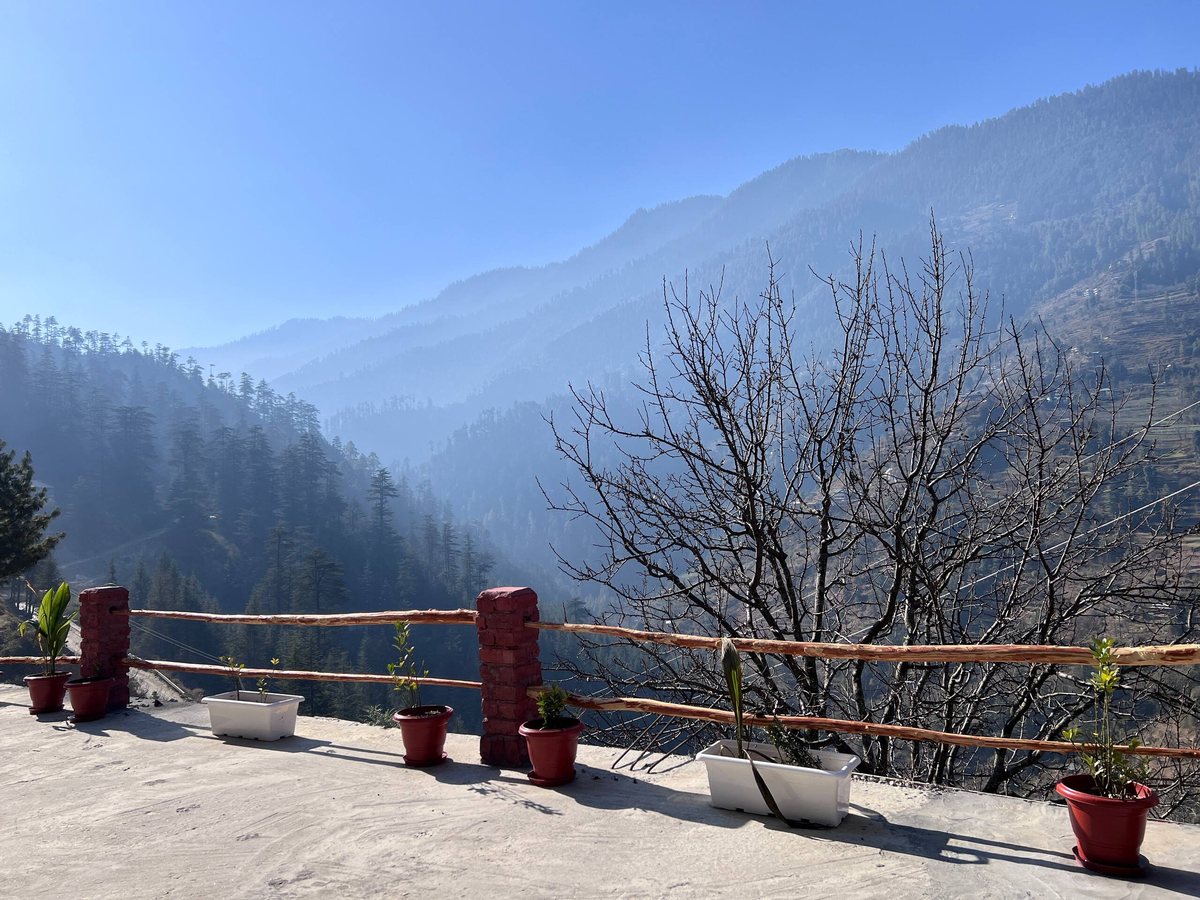
By definition, sunrise and sunset are the moments the top edge of the sun touches a level horizon. The USNO rise, set and twilight definitions say plainly that mountains on the horizon and the height of the observer can shift what you actually see. Jibhi sits at roughly 1,800 m with forested ridges rising around it, so in practice the sun clears the ridges some time after the official sunrise and drops behind them some time before the official sunset.
How much earlier or later depends on exactly where you stand and the time of year, and we have not timed it to the minute, so we will not pretend to. Two things are safe to plan on: the village goes into shade before the sky gets dark, and the higher slopes usually keep the light a little longer than the valley floor. On your first evening, notice when the light leaves your spot and plan the next day from that.
Is there a sunrise point or sunset point in Jibhi?
Not one that we can point you to with confidence. We do not know of an officially marked sunrise point or sunset point in Jibhi, and we would rather not send you up a path we have not checked to watch for a view we cannot promise. Any safe, open spot with a clear look down the valley works, and often the best one is where you are staying.
- Stay close at dusk. Village lanes and forest paths are dark after sunset; carry a torch and do not walk unfamiliar trails in the dark.
- The waterfall is a daytime walk. The path to the Jibhi waterfall is not lit, so go in the morning or early afternoon, not at sunset.
- Mornings are worth the alarm. On a clear morning, a cup of tea outside at first light is as good a sunrise plan as any.
Jalori Pass at sunrise or sunset
Jalori Pass sits at about 3,120 m on NH-305, roughly 12–14 km above Jibhi via Shoja, or about 45 minutes by car, and the road can close after heavy snow. Because it is so close, the clock times for sunrise and sunset there are almost the same as in the table above.
We do not suggest timing a drive for sunrise or sunset at the pass. A sunrise visit means climbing the hairpins before dawn, and a sunset visit means coming down them in the dark. In the colder months, frost and black ice are common on shaded bends in the morning and after sunset. A better plan: drive up mid-morning, walk to Serolsar Lake or towards Raghupur Fort in the middle of the day, and start back down with plenty of light to spare. Before you go, check the road; our Jalori Pass guide explains how.
Best months for clear sunrises and sunsets
- October to mid-November: the monsoon has gone, skies are usually clear and rain is rare. This is our pick for clear mornings and sharp evening light. See the best time to visit Jibhi.
- December to February: crisp, clear days between winter weather systems, and cloud, rain or snow while they pass. Keep a spare day if a clear sunrise matters to you.
- April to June: the next best window, with long days and mild evenings.
- July and August: monsoon rain and cloud; breaks in the cloud happen, but nobody can plan on them. September is wet early on and usually clears in the last week or two. See Jibhi in the monsoon.
Plan your day around the light
- From November to January, aim to be back by about 5 PM. With sunset between about 5:17 and 5:55 PM, the last stretch of road should be done in daylight. If you are driving in from Delhi, see Delhi to Jibhi by car.
- Switch the room heater on before sunset so the room is warm when the cold comes in.
- Carry a warm layer and a torch for any walk that might run past sunset.
- Check the cloud forecast two or three days out if a clear sunrise or sunset is the point of the trip.
- Then stay up for the stars. After the light goes, a clear night near the new moon is the next show; our stargazing in Jibhi guide has the dates.

Watching the light change from your cottage
For a couple, the glass house in Jibhi is for up to 2 guests: the bed sits right beside the glass and the cottage has a glass roof, and it has its own private hot tub facing the mountains. Late afternoon is hot-tub time, and when the light goes you can watch the sky without stepping into the cold. Room decoration, a cake and a candlelight dinner are available on request with 1 day's advance notice. For a sunset anniversary or a proposal, see our anniversary and proposal guide.
For a family, the mud house cottages in Chhet take up to 3 guests each or 6 with both, side by side with a shared patio and garden, a fire pit and a loft in each. You can drive right up to the door, which helps with parents and small children on short winter evenings, and our local chefs cook home-style meals from a menu, so nobody has to go out for dinner in the dark. For a bigger group, the whole property sleeps 10 comfortably, and when you book all three cottages there are no other guests on site.
All three have a room heater, hot water runs 24x7 and there is power backup. A bonfire can be arranged on request at an extra charge, and pets are welcome. Send your dates on WhatsApp and we will tell you what is free.
Sources: US Naval Observatory sun data (sunrise, sunset and civil twilight for Jibhi, checked 18 October 2026); USNO rise, set and twilight definitions; NOAA solar calculator and its calculation notes. Weather patterns and the Jalori Pass road notes are from our guides linked above. All times are approximate and for a level horizon; local ridges, weather and your exact spot change what you see.
Where to stay in Chhet, near Jibhi
Want to watch the light change from a warm cottage? Peaks N Valley Stays is in Chhet (PIN 175123), a few minutes past Jibhi. Every cottage has a room heater, hot water runs 24x7 and there is power backup if the valley supply drops. You can drive right up to the door and park free, our local chefs cook home-style meals, and pets are welcome.
Couples usually pick the glass house in Jibhi: the bed sits right beside the glass and the cottage has a glass roof, with a private hot tub and the valley beside you, for up to 2 guests. Families and friends take the mud house cottages in Chhet, up to 3 guests each or 6 with both, side by side with a shared patio. Room decoration, a cake and a candlelight dinner are available on request with 1 day's advance notice. A bonfire can be arranged on request at an extra charge.
What time is sunrise in Jibhi?
It depends on the month. Approximate sunrise times in Jibhi (IST, level horizon) are 6:23 AM in mid-October, 6:48 AM in mid-November, 7:12 AM in mid-December and 7:21 AM in mid-January, the latest of the year. In June the sun rises at about 5:15 AM. Direct sun reaches the valley a little later because of the surrounding ridges.
What time is sunset in Jibhi?
Approximate sunset times in Jibhi (IST) are 5:49 PM in mid-October, 5:22 PM in mid-November, 5:19 PM in mid-December and 5:39 PM in mid-January. The earliest sunsets, about 5:17 PM, come from late November to early December; the latest, about 7:30 PM, at the end of June. Usable light lasts only about 25 to 30 minutes after sunset.
Is there a sunset point in Jibhi?
We do not know of an officially marked sunrise or sunset point in Jibhi, so we do not name one. Any safe, open spot with a clear view down the valley works. Paths are dark after sunset and the waterfall path is not lit, so carry a torch and avoid unfamiliar trails at dusk.
Can you watch the sunset at Jalori Pass?
You can, but we do not suggest it: a sunset at Jalori Pass means driving the hairpins back down to Jibhi in the dark, and in the colder months frost and black ice are common on shaded bends after sunset. Go mid-morning instead, walk to Serolsar Lake in the middle of the day and start down with light to spare. The road can close after heavy snow.
What is the best time of year for clear sunrises and sunsets in Jibhi?
October to mid-November, when the monsoon has gone and skies are usually clear. December to February has crisp clear days between winter weather systems, with cloud or snow while they pass. April to June is the next best window. July and August bring monsoon cloud and rain.
Where to stay
Stay with us in Chhet, near Jibhi
- Glass House in Jibhi with a private hot tub, for couples
- Mud house cottages in Chhet, Tirthan Valley, for families and friends
- Pet friendly stay in Jibhi: every cottage welcomes dogs
- Book a cottage in Jibhi direct on WhatsApp