
Things to do · Camping
Camping in Jibhi: where it is allowed, and what to know
Park permits, registered campsites, Raghupur Fort and Serolsar, from people who host near Jibhi.
Short answer: camping near Jibhi is fine at registered campsites and designated eco-tourism sites. Inside the Great Himalayan National Park you need a permit and an approved route, multi-day trekkers must take certified guides and porters, open fires are forbidden and pets are not allowed. Paid camps must be registered with HP Tourism. The park gives March to November as the best camping months.
Camping in Jibhi sounds simple: pick a meadow, pitch a tent, light a fire. In practice, who allows what depends on where you are: inside the Great Himalayan National Park, on forest land, or at a paid campsite. This guide puts the official rules in one place. One honest note first: we run cottages in Chhet, near Jibhi, not a campsite, so nothing here is a sales pitch for tents.
Camping rules around Jibhi, at a glance
| Where or what | What applies | Source |
|---|---|---|
| Inside Great Himalayan National Park | Entry only with a permit; route approved by a range officer; certified guides and porters for multi-day treks | GHNP rules |
| Fires in the park | Open fires forbidden; cooking fires kept under control and put out with water before you leave camp | GHNP rules |
| Pets in the park | Pets are on the park's list of forbidden items | GHNP rules |
| A paid camp or glamping site | "Camps" are a tourism unit and must be registered before they operate | HP Act 2002, s.2(n) and s.25 |
| Camping on forest land | Meant for designated eco-tourism sites; tents and removable structures only | HP Eco-Tourism Policy 2024 |
| Sacred lakes and temples | Follow local custom and ask before pitching anywhere near a shrine | GHNP rules, local custom |
From the park's GHNP: Fees, rules and guidelines, the HP Tourism Development and Registration Act, 2002 and the HP Forest Department Eco-Tourism Policy 2024 (notified 29 October 2024). Rules change; confirm with the park range office or the campsite before you go.
Paid camps in Jibhi and Tirthan Valley
A search for a "Jibhi camping site" or "riverside camping in Jibhi" usually leads to ready camps with tents, a toilet block and meals. In Himachal, the HP Tourism Development and Registration Act, 2002 lists "camps" as a tourism unit, and every tourism unit has to apply for registration before it starts operating. So the simplest check is to ask the camp for its tourism registration before you pay.
- Registration: ask for the HP Tourism registration of the camp, as you would for a hotel.
- Toilets and water: attached or shared, and is there hot water in the morning?
- Distance from the river: rivers here rise quickly after heavy rain; a camp set well back from the water is the safer choice, and in July and August read Jibhi in monsoon first.
- Night cold: what sleeping bags and blankets are provided, and are they rated for the month you are going?
- Fires: is a bonfire allowed at that site, and who manages it?
- Road and rain plan: how far is the walk from the road, and what happens if it rains all night?
Camping inside the Great Himalayan National Park
The park's road route into the Tirthan valley runs via Larji, Shai Ropa and Gushaini, about 17 km from Jibhi. The park's own rules are clear: entry to the park is by permit, trekking routes must be discussed with and approved by a range officer, and multi-day trekkers must engage certified guides and porters (GHNP: Fees, rules and guidelines). Core-zone permits are issued at the head office in Shamshi and at the range offices in Shairopa (for the Tirthan valley) and Ropa (for the Sainj valley).
Once you are inside, the park asks campers to:
- find the next campsite well before sunset, with the local guide choosing a safe spot;
- never light open fires; cooking fires stay under the trek leader's control, and must be put out with water and the ashes smothered before you leave;
- not use live green wood;
- dig latrine pits about two feet deep and at least 100 m from any water source;
- carry all non-biodegradable litter out of the park and the ecozone, and leave the campsite at least as clean as you found it;
- keep noise low: radios only with headphones, and no parties.
Pets, firearms and firecrackers are on the park's list of forbidden items, as are hunting and fishing inside the park (GHNP: Fees, rules and guidelines). If you travel with a dog, plan your camping outside the park and read taking your dog to Jibhi. For routes and the permit process in more detail, see our Great Himalayan National Park guide.
Raghupur Fort, Serolsar and Jalori: can you camp there?
All three names show up in camping searches near Jibhi. The park's Banjar valley page describes good camping near Raghupur Fort, the old fort built by a king of Kullu, and in the area around Serolsar Lake, which is sacred to the goddess Budhi Nagin (GHNP: Banjaar Valley).
On the ground, things are more regulated now. In May 2025 the Forest Department removed tents in the Raghupurgarh area, and the local Divisional Forest Officer said tourism there would be organised "on the lines of Saryolsar", within a structured framework (The Tribune, 18 May 2025, news report). The state's HP Forest Department Eco-Tourism Policy 2024 (notified 29 October 2024) lists overnight camping and stargazing at designated sites as eco-tourism activities, and allows only tents and removable structures at those sites.
- Raghupur Fort: camp only where the forest staff or the local eco-tourism set-up allow it, and never inside the fort ruins.
- Serolsar Lake: treat the lake as a temple. Do not camp, cook or wash at the lake itself; ask the temple caretakers or forest staff where tents are allowed. More on the walk: Serolsar Lake trek.
- Jalori Pass: it usually closes after the first heavy snow, so winter camping up here is not realistic. Check whether Jalori Pass is open before you plan.
Best time for camping near Jibhi
The park says camping in GHNP stays accessible almost year-round, with the best conditions between March and November, and that core-zone trekking is best from April to June and from September to November (GHNP: Season based activities). In practice:
- April to June: the easiest camping weather; see Jibhi in summer.
- July and August: monsoon; rivers rise and roads can close, so stay away from riverside camps in these weeks.
- September to November: clear skies and cold nights; nights get cold fast, and colder the higher you camp, so carry a sleeping bag rated for the month.
- December to February: valley guides put Jibhi's December range at roughly -2 to 10°C, and higher camps are colder. Skip high-altitude camping in winter; see Jibhi in winter.
Leave no trace: the short version
- Carry every wrapper, bottle and cigarette end back down.
- Keep fires small and only where allowed, and never leave one smouldering.
- Keep music for headphones; sound carries a long way in these valleys.
- Ask before photographing people in villages or walking into their fields, and dress modestly near temples.
Want the night sky without the tent?
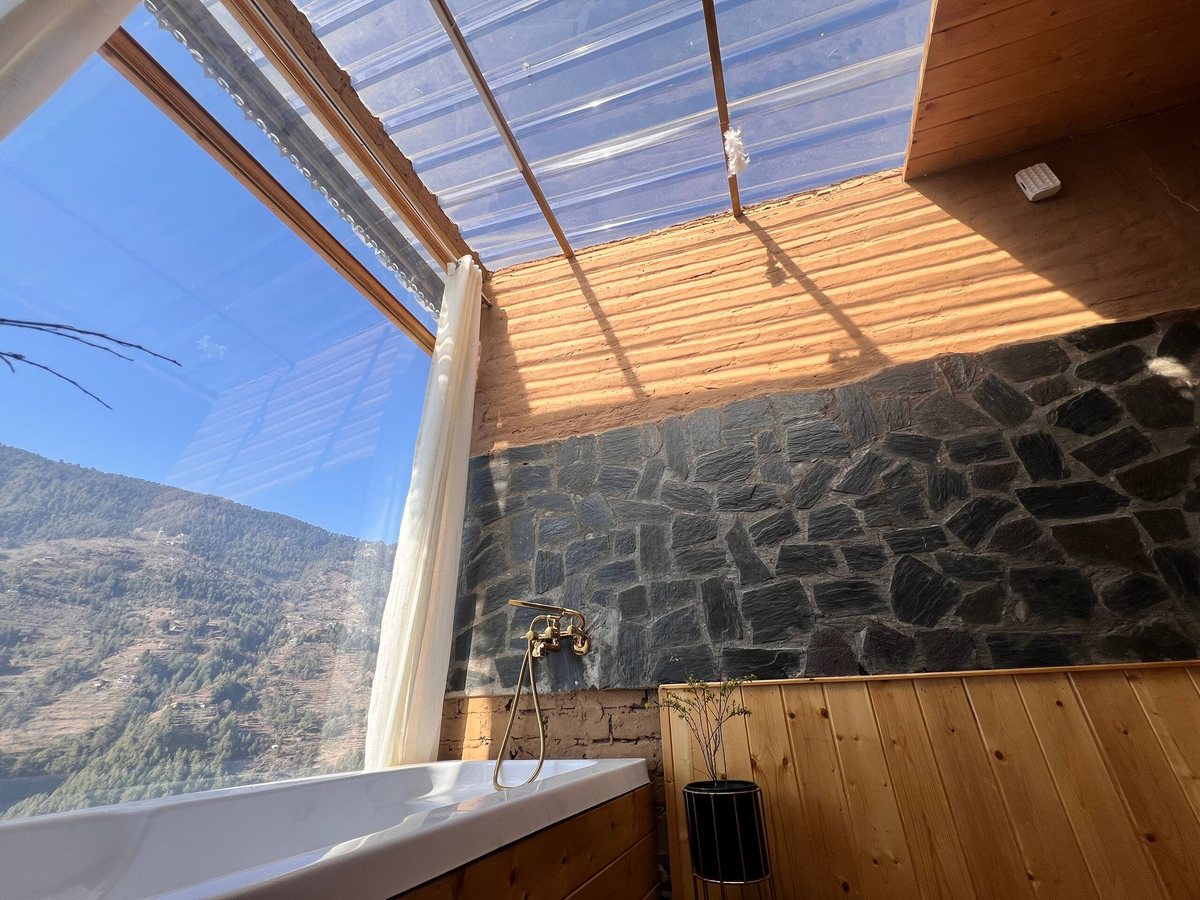
If what you want from camping is stars, a fire and quiet, you can have all three with a roof and a warm bed. For a couple, the glass house in Jibhi is for up to 2 guests: the bed sits right beside the glass and the cottage has a glass roof, and it has its own private hot tub facing the mountains. Room decoration, a cake and a candlelight dinner are available on request with 1 day's advance notice. On a clear night it is the closest thing to sleeping outside; read stargazing in Jibhi.
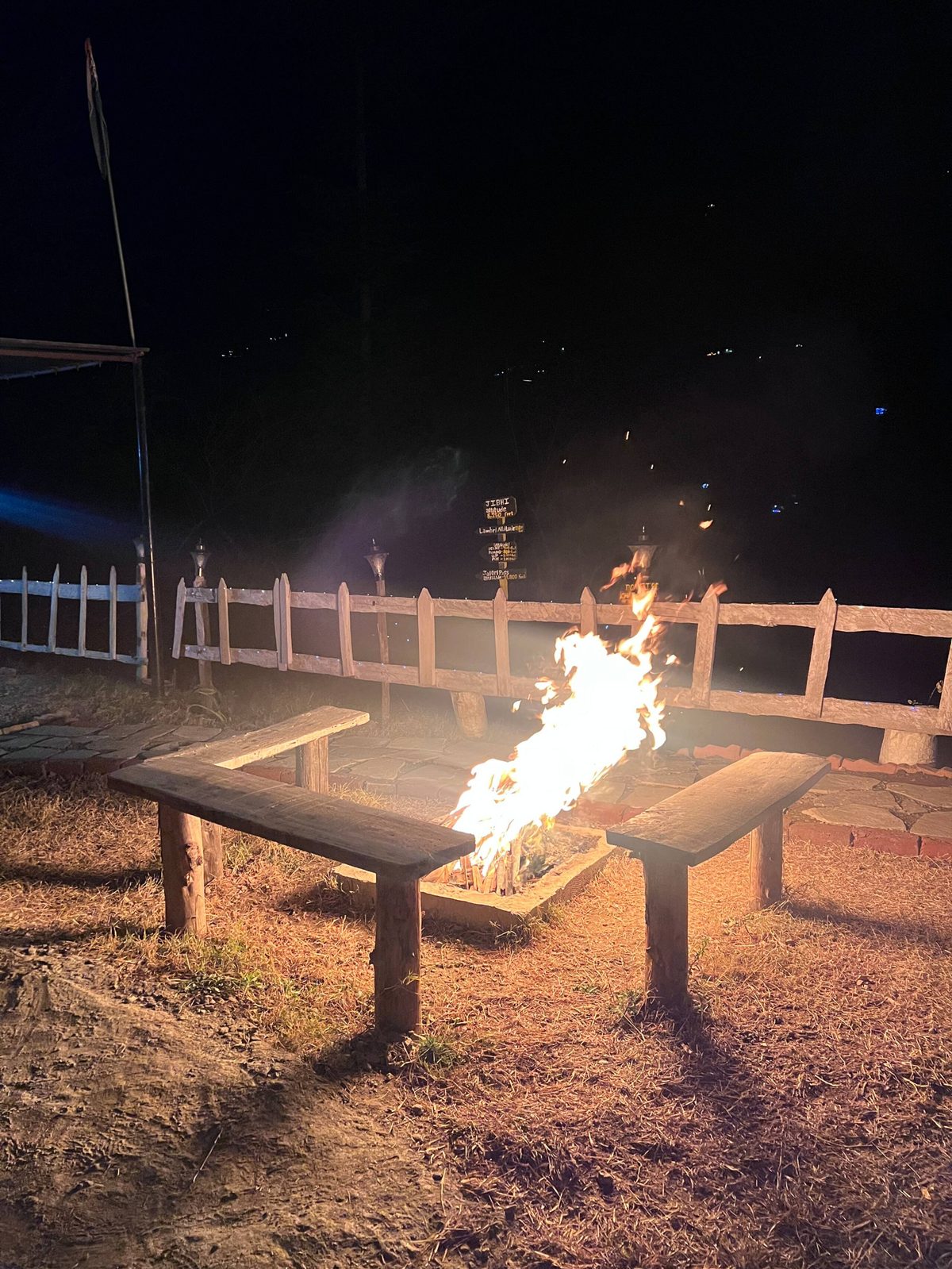
For a family, the mud house cottages in Chhet take up to 3 guests each or 6 with both, side by side with a shared patio and garden, a fire pit and a loft in each. For a group of friends who were thinking of a campsite, the whole property sleeps 10 comfortably, and when you book all three cottages there are no other guests on site.
All three have a room heater, hot water runs 24x7 and there is power backup. You can drive right up to the door, our local chefs cook home-style meals from a menu, and pets are welcome. Send your dates on WhatsApp and we will tell you what is free.
Sources: GHNP: Fees, rules and guidelines; GHNP: Season based activities; GHNP: Banjaar Valley; HP Tourism Development and Registration Act, 2002 (sections 2(n) and 25); HP Forest Department Eco-Tourism Policy 2024 (notified 29 October 2024); The Tribune, 18 May 2025. Checked on 18 October 2026. Rules can change; the park range office and the campsite have the final word.
Where to stay in Chhet, near Jibhi
Prefer a warm cottage to a tent? Peaks N Valley Stays is in Chhet (PIN 175123), a few minutes past Jibhi. Every cottage has a room heater, hot water runs 24x7 and there is power backup if the valley supply drops. You can drive right up to the door and park free, our local chefs cook home-style meals, and pets are welcome.
Couples usually pick the glass house in Jibhi: the bed sits right beside the glass and the cottage has a glass roof, with a private hot tub and the valley beside you, for up to 2 guests. Families and friends take the mud house cottages in Chhet, up to 3 guests each or 6 with both, side by side with a shared patio. Room decoration, a cake and a candlelight dinner are available on request with 1 day's advance notice. A bonfire can be arranged on request at an extra charge.
Is camping allowed in Jibhi?
Yes, at registered campsites and at designated eco-tourism sites. In Himachal, paid camps are a tourism unit and must be registered before they operate, and camping on forest land is meant for designated sites. Inside the Great Himalayan National Park you need a permit, an approved route and certified guides for multi-day treks.
Do I need a permit to camp in the Great Himalayan National Park?
Yes. Entry is by permit, and routes must be approved by a range officer. Core-zone permits are issued at the head office in Shamshi and at the range offices in Shairopa (Tirthan valley) and Ropa (Sainj valley). Multi-day trekkers must engage certified guides and porters.
Can we camp at Raghupur Fort or Serolsar Lake?
The park describes good camping near both, but the Forest Department now regulates tourism around Raghupurgarh, and Serolsar is a sacred lake. Camp only where the forest staff or the local eco-tourism set-up allow it, and never at the lake shore itself.
What is the best time for camping near Jibhi?
The park gives March to November as the best conditions for camping, with April to June and September to November best for core-zone treks. Avoid riverside camps in the July–August monsoon and high camps in winter.
Can I take my dog camping in the national park?
No. Pets are on the Great Himalayan National Park's list of forbidden items. Camp outside the park with your dog, or stay in a pet-friendly cottage and keep to forest walks outside the park.
Keep exploring
Related pages
Raghupur Fort trek from Jalori Pass: height, time, history → Glass house in Jibhi → Mud house cottages in Chhet → Whole property for groups (sleeps 10) → Great Himalayan National Park guide → Serolsar Lake trek → Stargazing in Jibhi → Places near Jibhi within 50 km → Treks around Chhet, Jibhi and Tirthan → Book and contact →Where to stay
Stay with us in Chhet, near Jibhi
- Glass House in Jibhi with a private hot tub, for couples
- Mud house cottages in Chhet, Tirthan Valley, for families and friends
- Pet friendly stay in Jibhi: every cottage welcomes dogs
- Book a cottage in Jibhi direct on WhatsApp