
Practical · Air quality
Jibhi AQI: how clean is the air in the Tirthan valley?
No monitor in the valley, so here is what the models say, what Delhi-NCR's stations measured this weekend, and how to check before you book.
Short answer: there is no official air-quality monitor in Jibhi or the Tirthan valley, so there is no measured "Jibhi AQI". Model estimates put Jibhi far below Delhi-NCR: at 2:30 PM IST on 19 October 2026, PM2.5 of about 4 µg/m³ in Jibhi against about 53 in central Delhi and 79 in Noida (CAMS model). From 15 October to 30 November in each of the last three years, the model never had a Jibhi day above India's 24-hour PM2.5 standard; central Delhi crossed it on 117 of 141 days. Read these as estimates, not readings.
Searching for the Jibhi AQI before you leave Delhi, Noida or Gurugram? We host guests in Chhet, a few minutes past Jibhi in the Tirthan valley, and we get why: October and November are when the plains' air turns. Here is the honest picture: what is measured, what is only modelled, how Jibhi compares with Delhi-NCR, and how to check for yourself before you book.
Is there an AQI monitor in Jibhi?
No. As far as the official lists show, there is no air-quality monitor in Jibhi, in Banjar or anywhere in the Tirthan valley. So nobody, us included, can give you a measured "Jibhi AQI today".
- Manual stations: CPCB's national list (as on 19 November 2024) has 25 manual stations at 14 places in Himachal Pradesh. The ones in Kullu district are at Manali (2), Vashisht (1) and Gulaba (1). None is in Banjar sub-division (CPCB list of manual monitoring stations (NAMP, as on 19.11.2024)).
- Live stations: CPCB's daily AQI bulletin for 18 October 2026 lists 273 cities. Baddi, with one station, is the only Himachal city on it (CPCB AQI bulletin, 18 Oct 2026).
- So if an app shows you a "Jibhi AQI" or "Tirthan valley AQI", it is a model estimate or a reading from somewhere else. That can still be useful, as long as you read it that way.
Jibhi vs Delhi and Noida: what the model says
The best way to compare Jibhi with Delhi-NCR is a global air-quality model. We used the Copernicus Atmosphere Monitoring Service (CAMS) forecasts, through the Open-Meteo air-quality API. They estimate PM2.5, the fine particles that were the main pollutant in Delhi's official reading on 18 October, on a grid about 45 km wide. These are model estimates, not measurements.
- Today: at 2:30 PM IST on 19 October 2026 the model put PM2.5 at about 4 µg/m³ for Jibhi, against about 53 µg/m³ for central Delhi and 79 µg/m³ for Noida.
- The next few days: the same model's forecast for 19–23 October has Jibhi's daily average between about 7 and 14 µg/m³, and central Delhi's between about 75 and 96 µg/m³.
- Smog season, three years running: from 15 October to 30 November in 2023, 2024 and 2025, the model never had a day in Jibhi above India's 24-hour PM2.5 standard of 60 µg/m³ (National Ambient Air Quality Standards, 2009 (CPCB)). Central Delhi crossed it on 117 of those 141 days, and Noida on 124.
| 15 Oct–30 Nov | Jibhi (model) | Central Delhi (model) | Noida (model) |
|---|---|---|---|
| 2023 | 10 µg/m³ 0 days over 60 | 79 µg/m³ 32 days over 60 | 88 µg/m³ 33 days over 60 |
| 2024 | 22 µg/m³ 0 days over 60 | 103 µg/m³ 43 days over 60 | 106 µg/m³ 45 days over 60 |
| 2025 | 18 µg/m³ 0 days over 60 | 96 µg/m³ 42 days over 60 | 102 µg/m³ 46 days over 60 |
Daily averages of the model's hourly PM2.5, rounded. "Days over 60" counts days above the 24-hour national standard. Source: CAMS global forecasts via Open-Meteo air-quality API, our calculation.
On CPCB's scale for PM2.5 alone, 130 of Jibhi's 141 model days in those three windows were in the "Good" band (0–30 µg/m³) and the other 11 were "Satisfactory". For central Delhi, the model had no "Good" day at all and 78 days in the "Poor" or "Very Poor" bands (CPCB: About the National Air Quality Index).
How to read an AQI number
India's National Air Quality Index was launched in October 2014 (PIB, 17 Oct 2014 (AQI launch)). It has six bands, and the overall AQI is set by whichever of up to eight pollutants is worst (CPCB: About the National Air Quality Index). For PM2.5, the bands are:
| CPCB AQI | Category | PM2.5, 24-hour (µg/m³) |
|---|---|---|
| 0–50 | Good | 0–30 |
| 51–100 | Satisfactory | 31–60 |
| 101–200 | Moderate | 61–90 |
| 201–300 | Poor | 91–120 |
| 301–400 | Very Poor | 121–250 |
| 401–500 | Severe | above 250 |
- CPCB's bulletin lists the possible health impacts for each band (CPCB AQI bulletin, 18 Oct 2026). We are not doctors, so we will not interpret them for you.
- India's 24-hour standard for PM2.5 is 60 µg/m³ and the annual one is 40 µg/m³ (National Ambient Air Quality Standards, 2009 (CPCB)). The WHO's 2021 guideline levels are stricter: 15 µg/m³ over 24 hours and 5 µg/m³ for the year (WHO global air quality guidelines, 2021).
- Many apps show a US AQI, which uses different bands from India's. A "150" on one is not a "150" on the other, so compare µg/m³ where you can, or stick to one scale.
This weekend in Delhi-NCR: the official readings
CPCB's bulletin gives each city's average AQI over the 24 hours to 4 PM. Here is what it showed on Saturday and Sunday (CPCB AQI bulletin, 17 Oct 2026; CPCB AQI bulletin, 18 Oct 2026):
| City (CPCB) | 17 Oct 2026 | 18 Oct 2026 |
|---|---|---|
| Delhi | 159 Moderate | 187 Moderate |
| Noida | 203 Poor | 170 Moderate |
| Greater Noida | 233 Poor | 274 Poor |
| Ghaziabad | 206 Poor | 213 Poor |
| Gurugram | 106 Moderate | 159 Moderate |
| Faridabad | 109 Moderate | 114 Moderate |
| Chandigarh | 59 Satisfactory | 58 Satisfactory |
| Dehradun | 49 Good | 51 Satisfactory |
| Rishikesh | 37 Good | 37 Good |
| Baddi (the only Himachal city listed) | 101 Moderate | 102 Moderate |
The main pollutant in Delhi on 18 October was PM2.5, and 58 of the city's 59 stations reported (CPCB AQI bulletin, 18 Oct 2026). An AQI of 187 is in the Moderate band, which for PM2.5 means 61–90 µg/m³. For the same 24 hours, the model gave central Delhi only about 58 µg/m³. If anything, the model's Delhi numbers on this page are on the low side.

Why Delhi-NCR's air turns in October and November
- The weather: when CAQM moved Delhi-NCR to Stage III of its action plan on 11 November 2025, it blamed the sharp rise on "calm winds, stable atmosphere and unfavourable meteorological conditions" (PIB, 11 Nov 2025 (GRAP Stage III)).
- The plan: CAQM's Graded Response Action Plan (GRAP) has four stages based on Delhi's AQI: Stage I "Poor" (201–300), Stage II "Very Poor" (301–400), Stage III "Severe" (401–450) and Stage IV "Severe+" (above 450). The schedule was revised on 29 September 2026 (CAQM GRAP schedule (revised 29.09.2026); PIB, 29 Sep 2026 (revised GRAP)).
- What to check: GRAP's own citizen charter asks you to check the AQI on CPCB's SAMEER app and the GRAP stage in force on the CAQM website (CAQM GRAP schedule (revised 29.09.2026)). We will not guess which stage applies on your travel day.
Why a hill valley usually reads cleaner
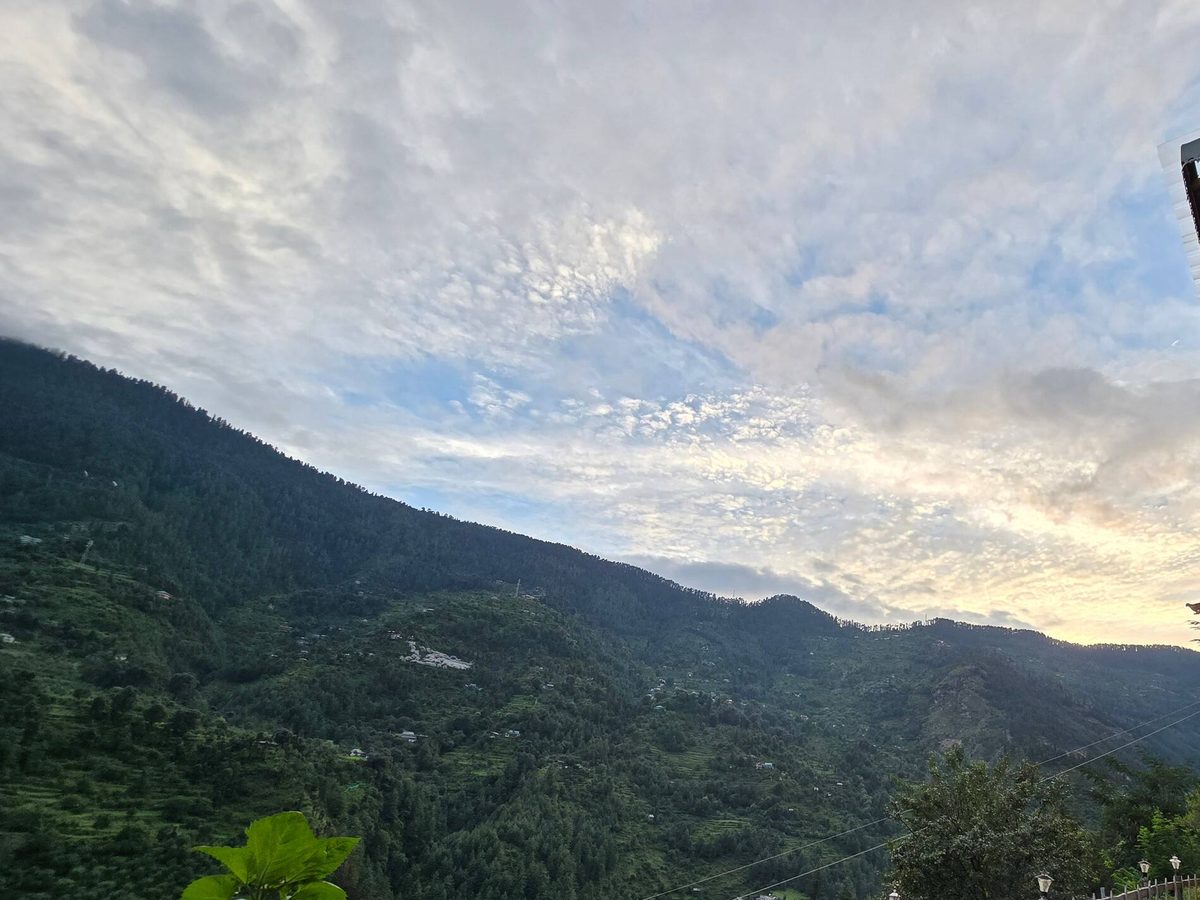
Jibhi is a small village at about 1,800 m, in a forested side valley of Kullu district, far from the cities and industry of the plains. The model reflects that: in every month of its record, Jibhi's cell reads far below central Delhi's.
| Month | Jibhi (model) | Central Delhi (model) |
|---|---|---|
| January | 26 µg/m³ | 121 µg/m³ |
| February | 19 µg/m³ | 73 µg/m³ |
| March | 14 µg/m³ | 68 µg/m³ |
| April | 13 µg/m³ | 58 µg/m³ |
| May | 17 µg/m³ | 74 µg/m³ |
| June | 20 µg/m³ | 70 µg/m³ |
| July | 18 µg/m³ | 54 µg/m³ |
| August | 15 µg/m³ | 53 µg/m³ |
| September | 15 µg/m³ | 49 µg/m³ |
| October | 13 µg/m³ | 71 µg/m³ |
| November | 18 µg/m³ | 105 µg/m³ |
| December | 20 µg/m³ | 107 µg/m³ |
Average of the model's daily PM2.5, September 2022 to September 2026 (4 or 5 years for each month), rounded. The model's Jibhi cell is centred near 31.6° N, 77.4° E at about 1,780 m and covers a much wider area than the village. Source: CAMS global forecasts via Open-Meteo air-quality API, our calculation.
- In the model, April and October are Jibhi's cleanest months (both about 13 µg/m³) and January is its haziest (about 26). November averages about 18 in Jibhi against about 105 in central Delhi.
- The model is not perfect for a mountain village. At 45 km wide, one grid cell spans ridges and valleys, and it cannot see a single chimney or a dusty stretch of road.
When the hills are not perfectly clean
- It is not always below the WHO guideline. In the model, Jibhi's daily PM2.5 was above the WHO 24-hour level of 15 µg/m³ on 32 of the 47 smog-season days in 2024 and 33 in 2025, though on only 1 in 2023 (WHO global air quality guidelines, 2021).
- Woodsmoke: on cold evenings, kitchen fires and bonfires add smoke that can sit in a valley for a while. The WHO lists fuel burning in households among the sources of particles (WHO, 22 Sep 2021).
- Road dust: where the highway is being dug or widened, dust can hang over a short stretch for a few hours.
- Haze: some days look softer and hazier from the terrace than others, and the model reads higher in some weeks too. Its highest single day for Jibhi in the 2024 smog-season window was about 49 µg/m³.
How to check before you book
- For Delhi-NCR: use CPCB's SAMEER app or the daily CPCB bulletin, which are based on real stations.
- For Jibhi: use a model forecast such as CAMS, and read it as an estimate for the wider area. The Kullu district stations (Manali, Vashisht, Gulaba) are manual stations in another valley, not live monitors (CPCB list of manual monitoring stations (NAMP, as on 19.11.2024)).
- For the weather: clear, dry days are the ones you want. Check a live forecast for Kullu district in the days before you travel.
- WhatsApp us and we will tell you what the sky has looked like this week. We do not measure the air at the cottages, so we will not quote you a number.
A slow clean-air break from Delhi-NCR
- Getting here: drive or take an overnight Volvo; see how to reach Jibhi from Delhi. Start early.
- Slow mornings: tea on the terrace, a village walk, an unhurried breakfast. See 5 things to do in Jibhi.
- A day out: Jalori Pass and Serolsar Lake if the road is open (Jalori and Serolsar guide), or the Jibhi waterfall closer by.
- Evenings: clear, dry nights are good for stargazing. Pack proper layers; our October–November packing list covers it.
- Around Diwali: if you want the festival break in the hills, see Jibhi at Diwali 2026, and book early.
Where to stay for a clean-air break
For a couple, the glass house in Jibhi is for up to 2 guests: the bed sits right beside the glass and the cottage has a glass roof, and it has its own private hot tub facing the mountains, a fine place to sit out on a clear day. Room decoration, a cake and a candlelight dinner are available on request with 1 day's advance notice.
For a family, the mud house cottages in Chhet take up to 3 guests each or 6 with both, side by side with a shared patio and garden, a fire pit and a loft in each. You can drive right up to the door, which helps with parents and small children, and our local chefs cook home-style meals from a menu. For a bigger group, the whole property sleeps 10 comfortably, and when you book all three cottages there are no other guests on site.
All three have a room heater, hot water runs 24x7 and there is power backup. A bonfire can be arranged on request at an extra charge, pets are welcome, and we can help arrange a taxi from Banjar or further down the valley (fares vary). Send your dates on WhatsApp and we will tell you what is free.
Sources: CPCB AQI bulletin, 18 Oct 2026; CPCB AQI bulletin, 17 Oct 2026; CPCB list of manual monitoring stations (NAMP, as on 19.11.2024); CPCB: About the National Air Quality Index; PIB, 17 Oct 2014 (AQI launch); National Ambient Air Quality Standards, 2009 (CPCB); WHO global air quality guidelines, 2021; WHO, 22 Sep 2021; CAQM GRAP schedule (revised 29.09.2026); PIB, 29 Sep 2026 (revised GRAP); PIB, 11 Nov 2025 (GRAP Stage III); model estimates from Copernicus Atmosphere Monitoring Service (CAMS) via Open-Meteo air-quality API (fetched 19 Oct 2026, 2:30–3:35 PM IST; our calculations). Model figures are estimates for a wide grid cell, not readings at Jibhi or at our cottages. Air quality changes by the hour, so check before you go.
Where to stay in Chhet, near Jibhi
Need a few days of clearer air? Peaks N Valley Stays is in Chhet (PIN 175123), a few minutes past Jibhi. Every cottage has a room heater, hot water runs 24x7 and there is power backup if the valley supply drops. You can drive right up to the door and park free, our local chefs cook home-style meals, and pets are welcome.
Couples usually pick the glass house in Jibhi: the bed sits right beside the glass and the cottage has a glass roof, with a private hot tub and the valley beside you, for up to 2 guests. Families and friends take the mud house cottages in Chhet, up to 3 guests each or 6 with both, side by side with a shared patio. Room decoration, a cake and a candlelight dinner are available on request with 1 day's advance notice. A bonfire can be arranged on request at an extra charge.
What is the AQI in Jibhi today?
There is no official air-quality monitor in Jibhi or the Tirthan valley, so there is no measured Jibhi AQI. Model estimates are the next best thing: at 2:30 PM IST on 19 October 2026 the CAMS model put PM2.5 at about 4 µg/m³ for Jibhi, against about 53 for central Delhi. Check a model forecast for the latest estimate.
Is the air in Jibhi clean in October and November?
In model estimates, usually far cleaner than Delhi-NCR. From 15 October to 30 November in 2023, 2024 and 2025, the CAMS model never had a day in Jibhi above India's 24-hour PM2.5 standard of 60 µg/m³, while central Delhi crossed it on 117 of 141 days. On some days Jibhi was still above the stricter WHO guideline.
Is there an AQI monitoring station in Kullu or the Tirthan valley?
Not in the Tirthan valley. CPCB's list of manual stations (as on 19 November 2024) has Kullu district stations at Manali, Vashisht and Gulaba only, and CPCB's daily bulletin for 18 October 2026 listed Baddi as the only Himachal city with a live reading.
Which places near Delhi had good AQI this weekend?
In CPCB's bulletin for 18 October 2026, Rishikesh was "Good" (37), and Dehradun (51) and Chandigarh (58) were "Satisfactory", while Delhi was 187 and Greater Noida 274. Most hill villages, Jibhi included, have no station, so compare them with a model forecast.
Why is Delhi's AQI bad in October and November?
Weather plays a big part. When CAQM moved Delhi-NCR to GRAP Stage III on 11 November 2025, it cited calm winds, a stable atmosphere and unfavourable meteorological conditions. GRAP has four stages based on Delhi's AQI; check the stage in force on the CAQM website and the AQI on CPCB's SAMEER app.
Where to stay
Stay with us in Chhet, near Jibhi
- Glass House in Jibhi with a private hot tub, for couples
- Mud house cottages in Chhet, Tirthan Valley, for families and friends
- Pet friendly stay in Jibhi: every cottage welcomes dogs
- Book a cottage in Jibhi direct on WhatsApp