
Plan · Monsoon
Jibhi in monsoon: is it safe to go?
July and August, honestly: rain, roads and when to pick another month.
Short answer: you can visit Jibhi in the monsoon, but plan for the road, not the weather. July and August are the wettest months, with rain on most days and averages of about 318 mm and 335 mm, and landslides can close NH-305 and smaller roads for hours or longer. Come only with flexible dates and a buffer day or two, drive in daylight, and check IMD warnings and District Kullu road notices before you set off. If your dates are fixed, choose June or October instead. At Peaks N Valley Stays in Chhet, near Jibhi, the Glass House and two Mudhouses have room heaters, 24x7 hot water and power backup.
Is it okay to go to Jibhi in July or August? The honest answer is that Jibhi in monsoon is beautiful and green, but the weather is not the main problem. The road is. This guide explains how wet July and August really are, what landslides have done to the road in recent seasons, how to check the road before you leave, and who should simply pick another month. We run cottages in Chhet, a few minutes past Jibhi, so we would rather you arrive safely than arrive on a fixed date.
Jibhi weather in the monsoon months
These are long-term averages for Jibhi village, not a forecast. They are the same figures we use in our month-by-month guide.
| Month | Avg high / low | Rain · wet days |
|---|---|---|
| June | 26°C / 15°C | 100 mm · ~14 |
| July | 24°C / 18°C | 318 mm · ~26 |
| August | 24°C / 17°C | 335 mm · ~25 |
| September | 23°C / 14°C | 178 mm · ~19 |
Approximate: daily ERA5 reanalysis data for Jibhi village, 2016–2025, via Open-Meteo, rounded. "Wet days" counts days with at least 1 mm of rain; reanalysis data tends to count light drizzle too, so read it as "rain on most days" rather than a downpour every day. For comparison, IMD's state-wide normal for Himachal Pradesh is about 256 mm in each of July and August; local totals vary a lot with terrain.
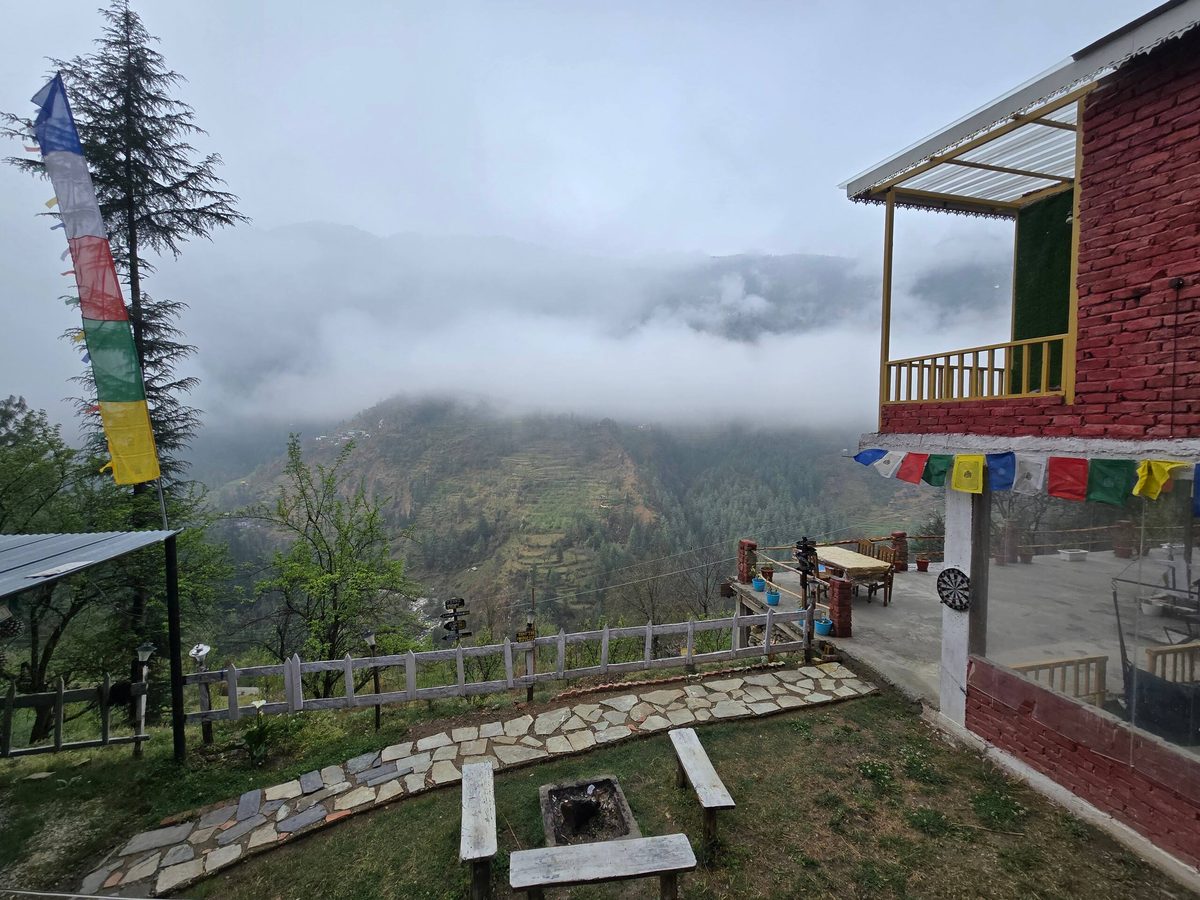
In short: it is not cold. Days stay in the low to mid-20s and nights are mild, but the air is damp, clouds sit low over the valley, and rain can be heavy for hours at a time. Clothes take a long time to dry. The upside is a valley that is greener than at any other time of year.
When the monsoon arrives and leaves
According to the India Meteorological Department's Shimla centre (Monsoon Report 2026), the monsoon normally covers all of Himachal Pradesh by 25 June and normally withdraws from the whole state by 25 September. Real years swing around those dates. Over the last ten years (2017–2026), onset ranged from 13 June to 2 July, and in every one of those years the monsoon left the state after 25 September, in seven of them only in October.
In 2026, IMD says the monsoon entered Himachal on 30 June and withdrew on 3 October. Seasonal rain for the state was within the normal range overall, but Kullu district, where Jibhi is, had "large excess" rain in July. So even a normal year on paper can be very wet locally.
The real risk is the road
The main road into Jibhi is NH-305, which climbs from the Aut tunnel past Larji and Banjar and then up to Jibhi and Jalori Pass. Our Aut to Jibhi guide covers the route. In heavy rain this road, and the smaller link roads off it, can be blocked by landslides, rockfall and debris from swollen streams.
Recent news reports show what that looks like (these are press reports, not official figures):
- Late June 2025: NH-305 was closed near Jibhi by a landslide and a flooded nallah, with vehicles stuck on both sides (Amar Ujala, 25 June 2025, Hindi).
- August 2025: the highway reopened, then closed again about 20 hours later after landslides at six points between Larji and Targali (Amar Ujala, August 2025, Hindi). Another closure lasted about 13 hours, with long queues that included tourists heading to Shoja and Jibhi (Amar Ujala, 20 August 2025, Hindi).
- September 2025: residents of Banjar told reporters NH-305 was still partly blocked 45 days after it was damaged, with long power and mobile network outages in the area (The Tribune, 13 September 2025). Later, The Tribune reported that HRTC buses between Aut and Banjar had resumed only after a break of about two and a half months, and a trial bus run beyond Banjar towards Ghiyagi failed because of damaged stretches.
2025 was an extreme season across Kullu and Mandi (on one August evening the state reported 389 roads closed, 104 of them in Kullu district, according to India Today), and not every year is like that. But it shows the pattern: closures can be short (a few hours while machines clear debris) or, after a bad spell, long. Nobody, including us, can promise the road will be open on your dates in July or August.
How to check the road before you go
- Weather warnings: look at the district-wise warnings from IMD Shimla for Kullu for your travel days. If there is an orange or red warning, postpone.
- Road notices: check the latest notice from the District Kullu administration or the police for your exact route, and look at the HPSDMA disaster portal. Check the date on any update; old posts get shared for days.
- Helplines: the HP State Disaster Management Authority lists 1077 for district emergency operation centres, 1070 for the state emergency operation centre and 112 for emergencies. Save them before you lose signal.
- Ask locally: message your stay or your driver the evening before and again in the morning. People on the route see a blockage first-hand, often before it shows up online.
- Forecasts are not road reports: a sunny forecast does not mean a road that was blocked yesterday has been cleared.

If you still go a monsoon checklist
- Buffer days: keep at least one spare day at the end, two if you have a flight or train to catch. Do not book a non-refundable onward ticket for the morning after you leave the hills.
- Daylight only: start early and plan to finish the mountain stretch before dark. Visibility drops fast in rain and mist, and debris is hard to see at night.
- Do not stop under cut slopes or next to streams, and never drive or walk through water flowing across the road. Wait, or turn back.
- Carry supplies: a full fuel tank, water, snacks, regular medicines, a power bank, some cash and offline maps, in case you wait for hours at a blockage.
- Self-drive: if you are not used to hill roads, the monsoon is not the time to learn. Our Delhi to Jibhi by car guide covers the route; in July and August consider a local taxi from Aut instead.
- Before you pay anyone: ask what happens to your booking if the road is officially closed on your dates.
- Pack for wet: a proper rain jacket, quick-dry clothes, shoes with grip, spare socks and a waterproof bag for phones.
Trails, rivers and waterfalls
The Great Himalayan National Park warns that monsoon rain makes trails slippery and risky, and its official season calendar puts the core-zone trekking windows in April to June and September to November, not in July and August. Keep walks short and on well-used paths.
Stay out of the river and out of waterfall pools when the water is high or muddy. Streams in this valley can rise quickly after rain higher up, even when it is dry where you are standing. The Jibhi waterfall is at its fullest in the monsoon; look from the bank. Trout fishing is not a monsoon plan either; see our trout fishing guide for the seasons and rules.
Who it suits, and who should skip it
- It can work if your dates are flexible, you are staying several nights, you like rain, mist and long slow days indoors, or you are happy to work from a cottage for a week and do not need to be anywhere on a fixed day.
- Skip it if it is your one big trip of the year, if you have a tight connection back, if you are travelling with elderly parents or a baby and cannot wait out a closure, or if you are a first-time hill driver.
- Better options: early to mid-June is warm and still mostly dry (see Jibhi in summer), and October is the most settled month of the year (see best time to visit Jibhi). Planning around holidays? Our long weekends 2027 guide shows which ones fall outside the monsoon.
Staying in Chhet on a rainy day
If the rain sets in, the cottage matters more than the itinerary. The glass house in Jibhi is for up to 2 guests: the bed sits right beside the glass and the cottage has a glass roof, so you can watch the clouds move through the valley without going outside, and it has its own private hot tub facing the mountains. There is a room heater for damp evenings and Wi-Fi with a work desk. Room decoration, a cake and a candlelight dinner are available on request with 1 day's advance notice.
The mud house cottages in Chhet take up to 3 guests each or 6 with both, side by side with a shared patio and garden and a loft in each. For a bigger group, the whole property sleeps 10 comfortably. Across the property, hot water runs 24x7, there is power backup if the valley supply drops, our local chefs cook home-style meals from a menu so you do not have to drive out in the rain, you can drive right up to the door and park free, and pets are welcome (see pet-friendly stay in Jibhi).

Where to stay in Chhet, near Jibhi
Thinking about Jibhi in July or August? Peaks N Valley Stays is in Chhet (PIN 175123), a few minutes past Jibhi. Every cottage has a room heater, hot water runs 24x7 and there is power backup if the valley supply drops. You can drive right up to the door and park free, our local chefs cook home-style meals, and pets are welcome.
Couples usually pick the glass house in Jibhi: the bed sits right beside the glass and the cottage has a glass roof, with a private hot tub and the valley beside you, for up to 2 guests. Families and friends take the mud house cottages in Chhet, up to 3 guests each or 6 with both, side by side with a shared patio. Room decoration, a cake and a candlelight dinner are available on request with 1 day's advance notice. A bonfire can be arranged on request at an extra charge.
Is it safe to visit Jibhi in the monsoon?
It can be, but it carries real road risk. July and August are the wettest months, and landslides can block NH-305 and link roads for hours or, after a bad spell, much longer. Go only with flexible dates and buffer days, drive in daylight, and check IMD warnings and District Kullu road notices before you leave.
How much does it rain in Jibhi in July and August?
Long-term averages for Jibhi village are about 318 mm in July and 335 mm in August, with rain on most days (ERA5 data via Open-Meteo, 2016–2025, rounded). Days stay around 24°C and nights around 17–18°C, so it is wet rather than cold.
Does the road to Jibhi close during the monsoon?
Sometimes. In 2025 news reports described NH-305 being closed near Jibhi by a landslide in late June, again at several points in August, and partly blocked for weeks in September. Short closures are common after heavy rain; long ones follow severe seasons. No one can guarantee the road on a given date.
How do I check Jibhi road conditions before travelling?
Check IMD Shimla district warnings for Kullu, the latest District Kullu administration or police notice for your route, and the HPSDMA disaster portal. Save 1077 (district emergency operation centre), 1070 (state) and 112. Then ask your stay or driver the evening before and again in the morning.
When does the monsoon end in Jibhi?
IMD gives 25 September as the normal date for the monsoon to leave Himachal Pradesh, but in each of the last ten years it left later, and in seven of them only in October. Late September is usually easing; October is the safest month to plan around.
Keep exploring
Related pages
Larji Dam and the three rivers: a guide from Jibhi → Jibhi in September, October end and the off season → Glass house in Jibhi → Mud house cottages in Chhet → Best time to visit Jibhi → Jibhi in summer (April to June) → Aut to Jibhi → Delhi to Jibhi by car → Jibhi Reddit questions answered → Long weekends 2027 → Book and contact →Where to stay
Stay with us in Chhet, near Jibhi
- Glass House in Jibhi with a private hot tub, for couples
- Mud house cottages in Chhet, Tirthan Valley, for families and friends
- Pet friendly stay in Jibhi: every cottage welcomes dogs
- Book a cottage in Jibhi direct on WhatsApp